
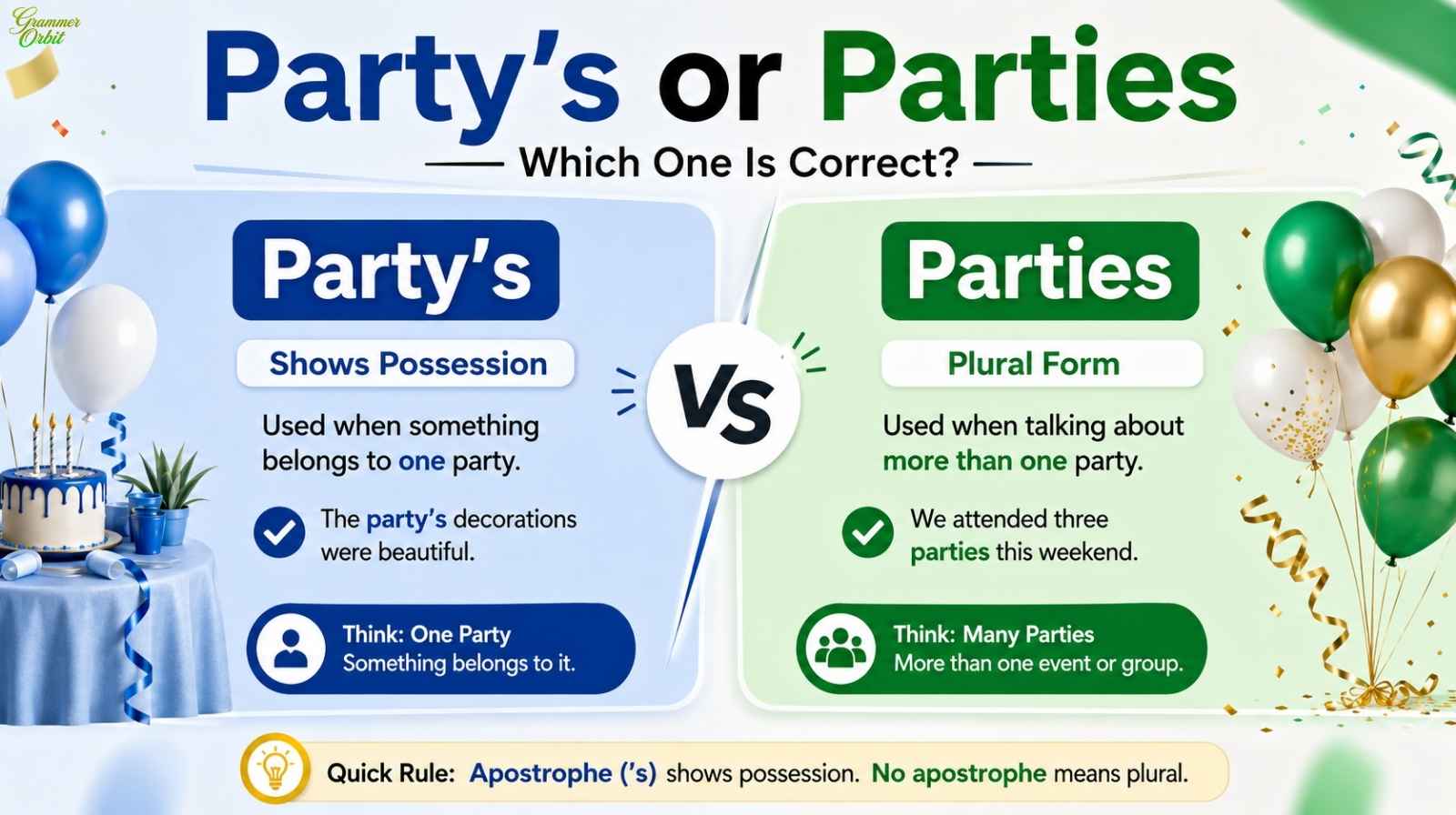
Have you ever typed “party’s” in a sentence and suddenly wondered if it should actually be “parties”? You are not alone. Many students, bloggers, English learners, and even native writers get confused between party’s or parties because both words look almost the same but have completely different meanings in grammar.
This confusion usually happens while writing emails, essays, captions, or blog posts. One small apostrophe can completely change the meaning of a sentence, which is why many people stop mid-writing just to figure out which spelling is correct. Although the difference may seem tricky at first, the rule is actually very simple once you understand it properly.
In this guide, you will learn the exact difference between party’s and parties, when to use each one correctly, common grammar rules, real sentence examples, easy memory tricks, and mistakes you should avoid. By the end, you will never confuse these two words again.
What Is the Difference Between Party’s and Parties?
The main difference is simple:
| Word | Meaning | Grammar Type |
|---|---|---|
| Party’s | Shows possession | Singular possessive noun |
| Parties | More than one party | Plural noun |
For example:
- The party’s music was too loud.
(The music belongs to one party.) - The parties started at different times.
(There were multiple parties.)
The apostrophe in party’s is what changes the meaning. Without it, the word becomes plural.
When to Use “Party’s” Correctly
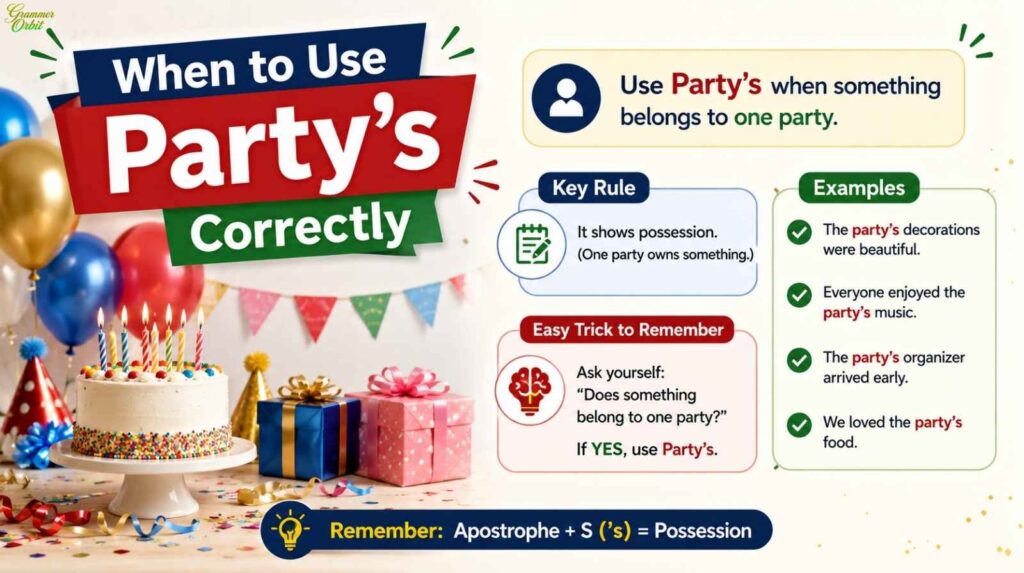
The word party’s is used when something belongs to one party.
Understanding Singular Possession
In English grammar, apostrophes often show ownership or possession. Since “party” is singular, adding apostrophe + s creates the possessive form.
Examples of “Party’s”
- The party’s decorations looked beautiful.
- Everyone enjoyed the party’s atmosphere.
- The party’s organizer arrived early.
- We loved the party’s playlist.
In all these examples, something belongs to one party.
Common Situations Where “Party’s” Appears
In Event Planning
- The party’s theme was tropical.
In Legal Writing
Interestingly, “party” can also refer to a person involved in a legal agreement.
- The party’s responsibilities are listed in the contract.
In Business Communication
- The party’s request was approved yesterday.
Therefore, “party’s” is not limited to birthdays or celebrations. It can also appear in formal and professional contexts.
Easy Trick to Remember “Party’s”
Ask yourself this question:
“Does something belong to one party?”
If the answer is yes, use party’s.
For example:
- The party’s cake
(The cake belongs to the party.)
This quick test works almost every time.
When to Use “Parties” Correctly
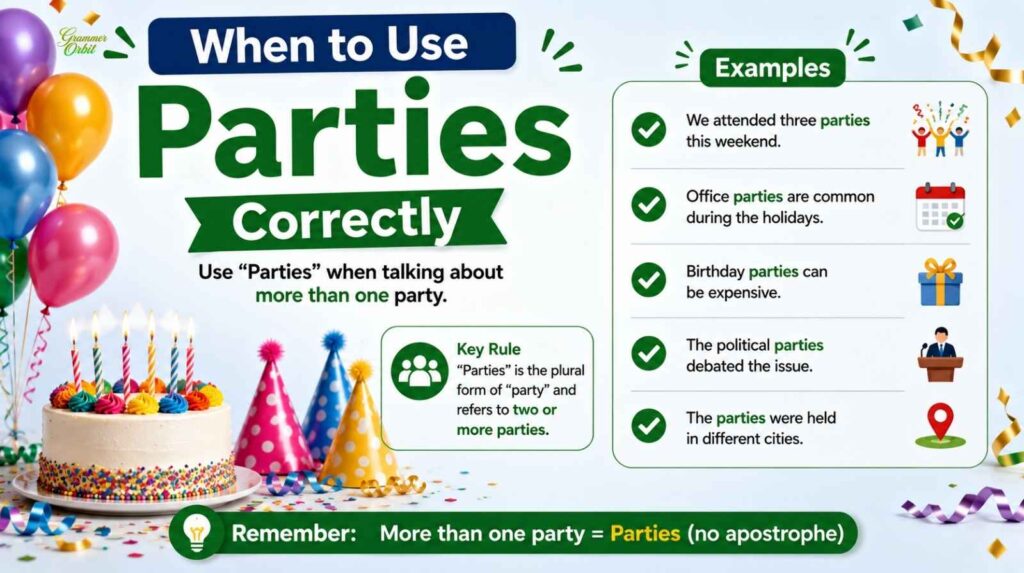
The word parties is simply the plural form of “party.”
Instead of adding “s,” English grammar changes the y to ies because “party” ends with a consonant + y.
Examples of “Parties”
- We attended three parties this weekend.
- Office parties are common during the holidays.
- Birthday parties can be expensive.
- The political parties debated the issue.
Here, the word refers to multiple groups, events, or organizations.
Why “Partys” Is Incorrect
One of the most common mistakes is writing:
❌ Partys
This spelling is incorrect because nouns ending in consonant + y usually form plurals by changing y → ies.
Similar Examples
| Singular | Correct Plural |
|---|---|
| Party | Parties |
| Baby | Babies |
| City | Cities |
| Story | Stories |
Therefore, “partys” is grammatically wrong in standard English writing.
Singular vs Plural Examples
Understanding the contrast side by side makes things easier.
| Singular | Plural |
|---|---|
| One party | Many parties |
| The party’s food | The parties’ locations |
| A birthday party | Birthday parties |
Notice how meanings shift depending on apostrophes and plural forms.
Party’s vs Parties in Real Sentences
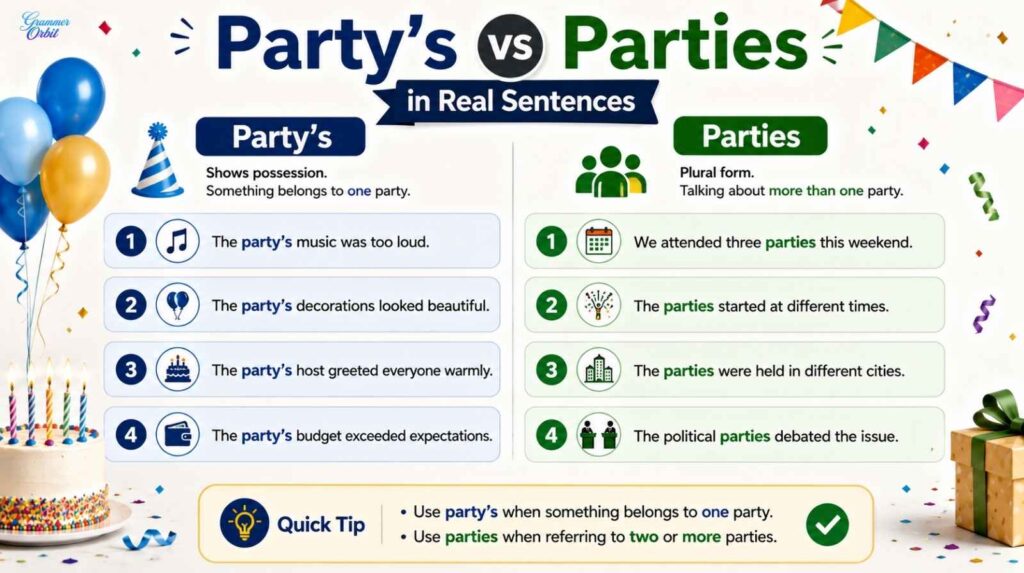
Sometimes grammar rules make more sense through natural examples.
Example 1
- The party’s balloons popped early.
(One party owned the balloons.) - The parties lasted all night.
(Multiple parties happened.)
Example 2
- The party’s host greeted everyone warmly.
- The parties were held in different cities.
Example 3
- The party’s budget exceeded expectations.
- The political parties disagreed strongly.
These examples show how context changes the meaning entirely.
Common Grammar Mistakes Writers Make
Many writers misuse apostrophes because English possessive rules can feel confusing. However, most mistakes fall into predictable patterns.
Mistake #1: Using Apostrophes for Plurals
❌ Birthday party’s every weekend
✔ Birthday parties every weekend
Apostrophes should not be used just to make words plural.
Mistake #2: Forgetting Possession
❌ The parties music was amazing
✔ The party’s music was amazing
Without the apostrophe, the sentence becomes grammatically incorrect.
Mistake #3: Mixing Up Singular and Plural Meaning
❌ The parties cake looked delicious
✔ The party’s cake looked delicious
Here, only one party owns the cake.
Quick Checklist to Avoid Errors
Before writing, check these points:
✔ Is it talking about more than one party? → Use parties
✔ Does something belong to one party? → Use party’s
✔ Is the apostrophe showing ownership? → Keep it
✔ Is the word simply plural? → No apostrophe needed
This simple checklist can prevent most grammar mistakes instantly.
Real-Life Example: How Small Grammar Mistakes Affect Professional Writing
In 2025, clear communication matters more than ever because businesses, schools, and online platforms rely heavily on written content. A single grammar mistake can sometimes affect credibility, especially in professional emails, legal documents, or published articles.
Consider a real example from an event-planning startup. The company created promotional posters for several corporate celebrations and wrote:
“Our company specializes in office party’s.”
Customers quickly pointed out the mistake on social media because the apostrophe incorrectly suggested possession instead of plurality. As a result, the brand had to redesign its promotional material and reprint advertisements, which cost additional time and money.
Later, the corrected version read:
“Our company specializes in office parties.”
This small correction immediately improved professionalism and readability.
The same issue often appears in business contracts. In legal writing, “party’s” may refer to one participant’s obligations, while “parties” refers to multiple people involved in the agreement. Misusing these words can create confusion about responsibility and ownership.
For bloggers, students, and marketers, grammar accuracy also impacts trust. Readers are more likely to engage with content that feels polished and correct. Therefore, learning small distinctions like party’s vs parties can significantly improve overall writing quality.
Grammar Rules Behind Party’s and Parties
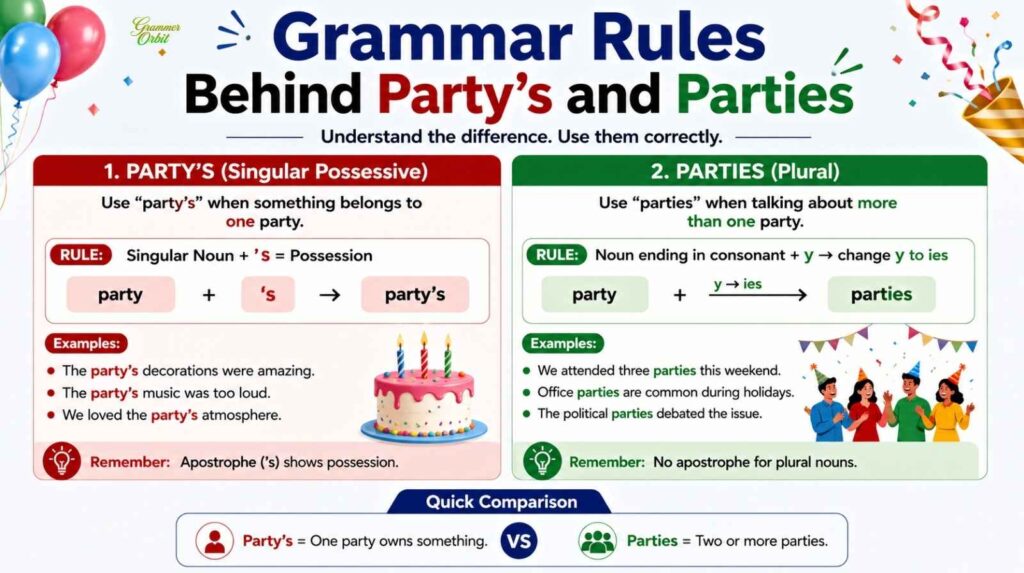
Understanding the grammar rule itself makes the topic much easier.
Rule for Possessive Nouns
To show ownership with a singular noun:
➡ Add apostrophe + s
Formula
Singular Noun+′s=Possession
Example:
- party → party’s
Rule for Plural Nouns Ending in Y
When a noun ends with consonant + y:
➡ Change y to ies
Formula
y→ies
Example:
- party → parties
This grammar pattern applies across hundreds of English words.
2025–2026 Grammar and Writing Trends
According to recent language-learning reports from platforms like Grammarly and HubSpot, grammar-related search queries continue to grow rapidly in 2025. Millions of users search for apostrophe rules, plural forms, and spelling corrections every month.
Recent educational publishing trends also show that short-form online writing has increased grammar confusion because people type quickly on mobile devices and social media platforms. Words involving apostrophes are among the most commonly searched grammar topics globally.
Additionally, SEO content editors now prioritize readability and grammar accuracy because Google’s helpful content systems reward high-quality human-focused writing. Therefore, understanding simple distinctions like party’s or parties is becoming increasingly valuable for students, bloggers, businesses, and digital writers.
For official grammar guidance, resources such as Merriam-Webster and educational style guides remain trusted references for English learners.
How to Remember the Correct Form Easily
Many learners memorize grammar better with shortcuts.
Use This Simple Memory Trick
“Apostrophe Means Ownership”
If something belongs to one party:
➡ Use party’s
If there are many parties:
➡ Use parties
Visual Memory Method
Think about it like this:
- party’s → one owner
- parties → many events/groups
This quick mental image helps avoid confusion while writing fast.
FAQs
Q1:Is “party’s” grammatically correct?
A: Yes. “Party’s” is correct when showing possession.
Example:
- The party’s decorations were colorful.
Q2:Is “parties” singular or plural?
A: Parties” is plural. It refers to more than one party.
Example:
- We attended several parties this month.
Q3:Why is “partys” wrong?
A: English grammar changes nouns ending in consonant + y into ies for plural forms.
Therefore:
❌ Partys
✔ Parties
Q4:What does “parties’” mean?
A: Parties’” is the plural possessive form.
Example:
- The parties’ agreements were signed yesterday.
This means multiple parties own something.
Q5:Which is correct: birthday party’s or birthday parties?
A: Both can be correct depending on meaning.
- Birthday parties = multiple celebrations
- Birthday party’s decorations = decorations belonging to one celebration
Q6:Is party’s used in legal English?
A: Yes. In contracts and legal documents, “party’s” often refers to one participant’s rights or obligations.
Conclusion
The difference between party’s or parties becomes simple once you understand the grammar rule behind each word.
- Party’s shows possession.
- Parties is the plural form of party.
Although the words look almost identical, the apostrophe changes the meaning completely. Therefore, paying attention to ownership versus plurality can instantly improve your grammar and writing clarity.
The next time you write emails, blog posts, contracts, essays, or social media captions, remember this easy rule:
If something belongs to one party, use party’s.
If you mean more than one party, use parties.
Mastering small grammar details like this can make your writing look more polished, professional, and trustworthy.
👉 Discover more simple and practical grammar guides on Grammer Orbit

Zia Ahmad is a professional blogger specializing in grammar tips and spelling accuracy. He creates clear, practical content that helps readers eliminate errors, strengthen writing skills, and communicate effectively for students, professionals, and everyday writers worldwide.